 |
Scarab
v2.9.1
Project 8 C++ Utility Library
|
|
Scarab
v2.9.1
Project 8 C++ Utility Library
|
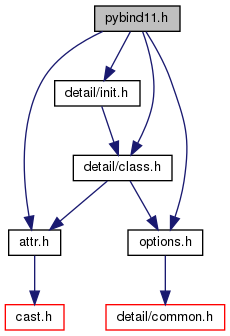
Go to the source code of this file.
Classes | |
| class | cpp_function |
| Wraps an arbitrary C++ function/method/lambda function/.. into a callable Python object. More... | |
| class | module |
| Wrapper for Python extension modules. More... | |
| class | generic_type |
| Generic support for creating new Python heap types. More... | |
| struct | has_operator_delete< T, SFINAE > |
| struct | has_operator_delete< T, void_t< decltype(static_cast< void(*)(void *)>(T::operator delete))> > |
| struct | has_operator_delete_size< T, SFINAE > |
| struct | has_operator_delete_size< T, void_t< decltype(static_cast< void(*)(void *, size_t)>(T::operator delete))> > |
| class | class_< type_, options > |
| struct | class_< type_, options >::is_valid_class_option< T > |
| struct | enum_base |
| class | enum_< Type > |
| Binds C++ enumerations and enumeration classes to Python. More... | |
| struct | iterator_state< Iterator, Sentinel, KeyIterator, Policy > |
| class | exception< type > |
| class | gil_scoped_acquire |
| class | gil_scoped_release |
Namespaces | |
| pybind11 | |
| glibc defines I as a macro which breaks things, e.g., boost template names | |
| pybind11::detail | |
Macros | |
| #define | PYBIND11_ENUM_OP_STRICT(op, expr, strict_behavior) |
| #define | PYBIND11_ENUM_OP_CONV(op, expr) |
| #define | PYBIND11_THROW throw type_error("Expected an enumeration of matching type!"); |
| #define | PYBIND11_OVERLOAD_INT(ret_type, cname, name, ...) |
| #define | PYBIND11_OVERLOAD_NAME(ret_type, cname, name, fn, ...) |
| #define | PYBIND11_OVERLOAD_PURE_NAME(ret_type, cname, name, fn, ...) |
| #define | PYBIND11_OVERLOAD(ret_type, cname, fn, ...) PYBIND11_OVERLOAD_NAME(PYBIND11_TYPE(ret_type), PYBIND11_TYPE(cname), #fn, fn, __VA_ARGS__) |
| #define | PYBIND11_OVERLOAD_PURE(ret_type, cname, fn, ...) PYBIND11_OVERLOAD_PURE_NAME(PYBIND11_TYPE(ret_type), PYBIND11_TYPE(cname), #fn, fn, __VA_ARGS__) |
Functions | |
| dict | globals () |
| template<typename T , typename = void_t<decltype(static_cast<void *(*)(size_t)>(T::operator new))>> | |
| void | set_operator_new (type_record *r) |
| Set the pointer to operator new if it exists. The cast is needed because it can be overloaded. More... | |
| template<typename > | |
| void | set_operator_new (...) |
| template<typename T , enable_if_t< has_operator_delete< T >::value, int > = 0> | |
| void | call_operator_delete (T *p, size_t, size_t) |
| Call class-specific delete if it exists or global otherwise. Can also be an overload set. More... | |
| void | call_operator_delete (void *p, size_t s, size_t a) |
| template<typename , typename F > | |
| auto | method_adaptor (F &&f) -> decltype(std::forward< F >(f)) |
| template<typename Derived , typename Return , typename Class , typename... Args> | |
| auto | method_adaptor (Return(Class::*pmf)(Args...)) -> Return(Derived::*)(Args...) |
| template<typename... Args> | |
| detail::initimpl::constructor< Args... > | init () |
| Binds an existing constructor taking arguments Args... More... | |
| template<typename... Args> | |
| detail::initimpl::alias_constructor< Args... > | init_alias () |
| template<typename Func , typename Ret = detail::initimpl::factory<Func>> | |
| Ret | init (Func &&f) |
| Binds a factory function as a constructor. More... | |
| template<typename CFunc , typename AFunc , typename Ret = detail::initimpl::factory<CFunc, AFunc>> | |
| Ret | init (CFunc &&c, AFunc &&a) |
| template<typename GetState , typename SetState > | |
| detail::initimpl::pickle_factory< GetState, SetState > | pickle (GetState &&g, SetState &&s) |
| void | keep_alive_impl (handle nurse, handle patient) |
| __attribute__ ((noinline)) inline detail | |
| Return the type info for a given C++ type; on lookup failure can either throw or return nullptr. More... | |
| keep_alive_impl (get_arg(Nurse), get_arg(Patient)) | |
| std::pair< decltype(internals::registered_types_py)::iterator, bool > | all_type_info_get_cache (PyTypeObject *type) |
| template<return_value_policy Policy = return_value_policy::reference_internal, typename Iterator , typename Sentinel , typename ValueType = decltype(*std::declval<Iterator>()), typename... Extra> | |
| iterator | make_iterator (Iterator first, Sentinel last, Extra &&... extra) |
| Makes a python iterator from a first and past-the-end C++ InputIterator. More... | |
| template<return_value_policy Policy = return_value_policy::reference_internal, typename Iterator , typename Sentinel , typename KeyType = decltype((*std::declval<Iterator>()).first), typename... Extra> | |
| iterator | make_key_iterator (Iterator first, Sentinel last, Extra &&... extra) |
| template<return_value_policy Policy = return_value_policy::reference_internal, typename Type , typename... Extra> | |
| iterator | make_iterator (Type &value, Extra &&... extra) |
| template<return_value_policy Policy = return_value_policy::reference_internal, typename Type , typename... Extra> | |
| iterator | make_key_iterator (Type &value, Extra &&... extra) |
| template<typename InputType , typename OutputType > | |
| void | implicitly_convertible () |
| template<typename ExceptionTranslator > | |
| void | register_exception_translator (ExceptionTranslator &&translator) |
| template<typename CppException > | |
| exception< CppException > & | get_exception_object () |
| template<typename CppException > | |
| exception< CppException > & | register_exception (handle scope, const char *name, PyObject *base=PyExc_Exception) |
| for (size_t i=0;i< check.size();i++) | |
| if (kwargs.contains("file")) | |
| write (line) | |
| write (kwargs.contains("end") ? kwargs["end"] :cast("\)) | |
| if (kwargs.contains("flush") &&kwargs["flush"].cast< bool >()) file.attr("flush")() | |
| template<return_value_policy policy = return_value_policy::automatic_reference, typename... Args> | |
| void | print (Args &&...args) |
| function | get_type_overload (const void *this_ptr, const detail::type_info *this_type, const char *name) |
| template<class T > | |
| function | get_overload (const T *this_ptr, const char *name) |
Variables | |
| size_t | Patient |
| size_t function_call & | call |
| size_t function_call handle | ret |
| dict | kwargs |
| auto | sep = kwargs.contains("sep") ? kwargs["sep"] : cast(" ") |
| auto | line = sep.attr("join")(strings) |
| object | file |
| else | |
| #define PYBIND11_ENUM_OP_CONV | ( | op, | |
| expr | |||
| ) |
Definition at line 1464 of file pybind11.h.
| #define PYBIND11_ENUM_OP_STRICT | ( | op, | |
| expr, | |||
| strict_behavior | |||
| ) |
Definition at line 1455 of file pybind11.h.
| #define PYBIND11_OVERLOAD | ( | ret_type, | |
| cname, | |||
| fn, | |||
| ... | |||
| ) | PYBIND11_OVERLOAD_NAME(PYBIND11_TYPE(ret_type), PYBIND11_TYPE(cname), #fn, fn, __VA_ARGS__) |
Macro to populate the virtual method in the trampoline class. This macro tries to look up the method from the Python side, deals with the :ref:gil and necessary argument conversions to call this method and return the appropriate type. This macro should be used if the method name in C and in Python are identical. See :ref:overriding_virtuals for more information.
.. code-block:: cpp
class PyAnimal : public Animal { public: Inherit the constructors using Animal::Animal;
Trampoline (need one for each virtual function) std::string go(int n_times) override { PYBIND11_OVERLOAD_PURE( std::string, // Return type (ret_type) Animal, // Parent class (cname) go, // Name of function in C++ (must match Python name) (fn) n_times // Argument(s) (...) ); } };
Definition at line 2145 of file pybind11.h.
| #define PYBIND11_OVERLOAD_INT | ( | ret_type, | |
| cname, | |||
| name, | |||
| ... | |||
| ) |
Definition at line 2079 of file pybind11.h.
| #define PYBIND11_OVERLOAD_NAME | ( | ret_type, | |
| cname, | |||
| name, | |||
| fn, | |||
| ... | |||
| ) |
Macro to populate the virtual method in the trampoline class. This macro tries to look up a method named 'fn' from the Python side, deals with the :ref:gil and necessary argument conversions to call this method and return the appropriate type. See :ref:overriding_virtuals for more information. This macro should be used when the method name in C is not the same as the method name in Python. For example with __str__.
.. code-block:: cpp
std::string toString() override { PYBIND11_OVERLOAD_NAME( std::string, // Return type (ret_type) Animal, // Parent class (cname) toString, // Name of function in C++ (name) "__str__", // Name of method in Python (fn) ); }
Definition at line 2109 of file pybind11.h.
| #define PYBIND11_OVERLOAD_PURE | ( | ret_type, | |
| cname, | |||
| fn, | |||
| ... | |||
| ) | PYBIND11_OVERLOAD_PURE_NAME(PYBIND11_TYPE(ret_type), PYBIND11_TYPE(cname), #fn, fn, __VA_ARGS__) |
Macro for pure virtual functions, this function is identical to :c:macro:PYBIND11_OVERLOAD, except that it throws if no overload can be found.
Definition at line 2152 of file pybind11.h.
| #define PYBIND11_OVERLOAD_PURE_NAME | ( | ret_type, | |
| cname, | |||
| name, | |||
| fn, | |||
| ... | |||
| ) |
Macro for pure virtual functions, this function is identical to :c:macro:PYBIND11_OVERLOAD_NAME, except that it throws if no overload can be found.
Definition at line 2117 of file pybind11.h.
| #define PYBIND11_THROW throw type_error("Expected an enumeration of matching type!"); |
 1.8.13